Thursday, May 17, 2007

SMTPBeamer on my Windows 2003 Web server

SMTPBeamer on my Windows 2003 Web server


This is an easy-to-set-up e-mail server. Enable advanced features as you go. I started out downloading the catchall POP3 mail from my first hosted domain years ago with SMTPBeamer. Today, I use SMTPBeamer on my Windows 2003 Web server. It handles the mail for all my domains and the domains I host. You can setup SMTPBeamer yourself. Just follow the instructions on the bottom of this page.

read more...

Peter Banz

D.3 Post Office Protocol v3 (POP3)

D.3 Post Office Protocol v3 (POP3)

SMTP is only useful as a transport protocol between mail servers. It does not deliver mail to a user’s mailbox, nor allow remote users to retrieve mail from the server. Local delivery is a function of the mail system in use. For example, cc:Mail uses a disk-based postoffice to store mail for each individual user on that system. An SMTP server for cc:Mail would accept messages on behalf of the cc:Mail users, but would not necessarily deliver that mail to the user. The cc:Mail postoffice server would likely handle the local delivery independently of the SMTP gateway.

read more...

ready pop .Net POP3 E-mail Component

Product Features
Download the ReadyPOP User Manual
  • ReadyPOP is a .Net library for retrieving email messages from a POP3 mailserver, checking mailbox status and parsing retrieved messages from Visual Basic .Net, C# .Net, ASP .Net and other programming and scripting languages that support the .Net framework.
  • Easy to use - No need to understand the POP3 protocol.
  • Access UIDL (unique message ID), message Date (automatically converted to local time zone), From address, To address, CC address, Subject, Plain Text Body, HTML Body all by name.
  • Easily return a list of file attachments without having to first save them.
  • Easily save all file attachments to the directory of your choice.
  • Fully supports MIME, Base64 and Quoted Printable.
  • Complete working ASP.net sample application that clearly demonstrates how to use the ReadyPOP .Net component.
read more...

Setting Up POP3 and SMTP E-Mail Accounts in Outlook XP

Setting Up POP3 and SMTP E-Mail Accounts in Outlook XP

by David Horowitz

Perhaps you’d like to learn a little more about setting up POP3/SMTP access from Outlook. Well, you’re in luck – keep reading!

POP3 - The Technical Stuff

POP3 stands for Post Office Protocol - Version 3. The “governing body” that specifies how POP3 works is the Internet Engineering Task Force (IETF). The IETF main web site is www.ietf.org. You can find detailed information about POP3 on the IETF RFC Editor web site – www.rfc-editor.org. Specifically, the POP3 specification document can be found at ftp://ftp.rfc-editor.org/in-notes/rfc1939.txt.


read more...

Saturday, May 12, 2007

A POP3 Client in C# .NET

A POP3 Client in C# .NET
By Desmond McCarter.

Introduction

I was asked some time ago to develop software which involved extracting bodies and subject lines from emails. "Humm ...", I thought, "connect to mail server on 110, send POP3 commands, receive data, sorted!". Indeed, at my first attempt it was a piece of cake: reading emails - no problem. Colleagues working at my company were evangelizing about what we could do: "Yeah mate, we can automatically process emails, no sweat".

read more...

P3Scan Current version: 2.3.2

P3Scan Current version: 2.3.2
p3scan-development P3PMail

Introduction

This is a full-transparent proxy-server for email clients. It runs on a Linux box with iptables (for port re-direction)[1]. It can be used to provide email scanning from the internet, to any internal network and is ideal for helping to protect your "Other OS" LAN from harm, especially when used in conjunction with a firewall and other Internet Proxy servers.

It is designed to enable scanning of incoming/outgoing email messages for Virus's, Worms, Trojans, Spam (read as "Un-solicited Bulk Email"), and harmfull attachments. Because viewing HTML mail can enable a "Spammer" to validate an email address (via Web bugs), it can also provide HTML stripping.

This project is maintained by Jack S. Lai .

P3Scan is a derived work of POP3VScan as written by Folke Ashberg .

It's intent is to provide a follow on program to POP3-Virusscan-Proxy 0.4

It is based upon his program but provides numerous changes to include scanning email for spam, hardening the program, addaption to today's email environment, and many, many other changes.

read more...

POP3 Providers

POP3 Providers

These providers only offer POP3/SMTP access. POP3 accounts may also be viewed on the web using a "Reader." Note: Many web-based and non-USA providers also offer POP3 accessibility.

read more...

Fusion POP3

Fusion POP3

Introducing Fusion POP3
The Fusion POP3 client package provides, via
API functions, a complete implementation of
RFC1939 “Post Office Protocol - Version 3”.
Security is implemented via Fusion Net’s MD5
(RFC 1321) capabilities. Callback functions can
be registered for each phase of the conversation
between the server and the client. This allows the
programmer visibility into the workings of the
protocol and assists in debugging.
The Fusion POP3 client simplifies access to
email. Instead of just providing the commands
spelled out in RFC1939 the interface in has been
partitioned into logical blocks. Each block may
make use of multiple RFC commands.

read more...

POP3 Cleaner PRO: a freeware anti-spam solution for everyone

POP3 Cleaner PRO: a freeware anti-spam solution for everyone

POP3 Cleaner PRO is a powerful mailbox cleaning utility for Windows. You can preview and delete unwanted e-mail messages directly from the mail server and then you can retrieve the rest with your e-mail client (e.g. MS Outlook). Every message is shown with its sender's address, subject, size and the date it was received by the server. POP3 Cleaner PRO can also run fully automated on the system tray and act as a powerful anti-spam filter. It can connect to the mail server in desired time intervals, check for the new mail (notify you on new mail arrival), apply the anti-spam rules and delete the unwanted messages directly from the mail server.

read more...

SMTP/POP3 Email Engine Library for Delphi

SMTP/POP3 Email Engine Library for Delphi

The MarshallSoft SMTP/POP3 Email component Library for Delphi (SEE4D) is a library of functions providing easy control of the SMTP (Simple Mail Transport Protocol) and POP3 (Post Office 3) protocols.

The SMTP/POP3 Email development toolkit provides a simple interface to send and receive email, including multiple MIME base64 and quoted-printable encoded attachments from within a Borland Delphi application. Knowledge of Winsock and TCP/IP is not needed.

SEE4D provides the functionality to easily and quickly develop software applications that can send, receive and parse mail.

read more...

Secure IMAP (and POP3)

Secure IMAP (and POP3)

v 2.6
26 November 2001

Roberto Cecchini

Versione in italiano


Contents

Introduction
OpenSSL Installation
Certificate Request and Installation
stunnel Installation
stunnel on the Server
E-mail Clients (Unix) Configuration
E-mail Clients (Windows) Configuration


read more...

Free IMAP, POP3 Email Mailboxes, Web Email, Email Forwarding or Redirection

Free IMAP, POP3 Email Mailboxes, Web Email, Email Forwarding or Redirection

These free services give you a free email address with either a POP3 mailbox access, IMAP access, web email access, or email aliases that will forward or redirect email sent to that address to another. They may be used by people who are looking for an email address that is independent of their ISP, and thus hopefully more permanent that that given by the ISP.


read more...

eMail2Pop Logo - AOL Gmail Outlook Express POP3

eMail2Pop Logo - AOL Gmail Outlook Express POP3
Liberate your mail! eMail2Pop™ interfaces with

AOL® mail, Gmail™ and Outlook

to provide

POP3 and SMTP access

to AOL Mail and Gmail accounts. eMail2Pop converts AOL and Gmail mail into a standard mail format. This means that users can retrieve their AOL / Gmail mail from almost any email program (Microsoft Outlook, Eudora mail, Incredimail, etc) instead of using proprietary mail software.

read more...


How to Enable and Interpret the Pop3.log File

How to Enable and Interpret the Pop3.log File

This article was previously published under Q155515
On This Page
MORE INFORMATIONLog Example - Failed Login

read more...

Baby POP3 Server Version 1.04

Baby POP3 Server Version 1.04
In the past I have done several projects related to e-mail (POP3/SMTP/IMAP4). One of the problems (at least in my company) is that there are never good test servers available. So that's why I decided to create this simple POP3 server, which doesn’t take many resources and supports most of the standard POP3 commands.

read more...

MailBee POP3 Component

MailBee POP3 Component
Try It!
Download Free Trial

MailBee POP3 Component

Enables your application or ASP web page to reliably and securely receive Internet mails via POP3 protocol

What's new

  • Supports decryption/verification of received messages (via SSL/SMIME plugin)

Overview

MailBee POP3 allows you to easily implement e-mail managing and retrieval in ASP, VB or any other ActiveX-capable environment. It supports secure authentication to POP3 server, partial retrieval of the messages, determining message sizes without downloading message headers, deleting messages, parsing and decoding messages into easy-to-use Message objects

No knowledge of SMTP, POP3, IMAP4 and MIME is required!

MailBee POP3 includes main POP3 object (which implements POP3 protocol) and Message object (which is used for message parsing). Message object is common across all MailBee objects, thus allowing intercommunication between POP3 and SMTP objects

read more...

Rebex Mail for .NET Features - POP3

Rebex Mail for .NET Features - POP3

POP3 is a protocol for retrieving mail from a mailbox on a remote server. It is a simple protocol that does not provide any advanced mail or folder management capabilities - these are offered by IMAP, and an IMAP component is a part of Rebex Mail for .NET as well.


read more...

popa3d - a tiny POP3 daemon

popa3d - a tiny POP3 daemon

popa3d is a tiny POP3 daemon designed with security as the primary goal. You can read more about its design, check out the change log, or download a popa3d tarball (the latest stable version is recommended) and refer to the documentation inside.

read more...

Tuesday, May 8, 2007

Gordano Knowledge Base

Gordano Knowledge Base
Article Q1443

What is POP3?

Answer:
POP (Post Office Protocol) is used to provide simple remote access to mailboxes. POP3 is the latest version of POP. With POP3, once mail clients connect and download their messages, the messages are typically removed from the server and stored on the client's local machine.

This means that you have to ensure that the all the machines are backed up in order to prevent you loosing any information in email messages. To resolve this problem, you could use the IMAP4 or Web Mail clients which allow messages to be manipulated on the server.


read more...

Gordano Knowledge Base

Gordano Knowledge Base
Article Q0471

What is POP3 and how does it compare to IMAP4?

Answer:
POP (Post Office Protocol) is used to provide simple remote access to mailboxes. POP3 is the latest version of POP. With POP3, once mail clients connect and download their messages, the messages are typically removed from the server and stored on the client's local machine.

IMAP (Internet Message Access Protocol) is richer in functionality than POP and is designed to allow clients to access and manage mailboxes on the server as if they were local. IMAP is a much more complex protocol than POP, with less client support.


read more...

checkpw-pop3

checkpw-pop3

What is it?

checkpw-pop3 is a checkpassword compatible program that authenticates against a POP3 server.

It is useful when one needs to use SMTP AUTH with an SMTP server that cannot directly access the POP3 server or user account database.

This software is public domain.


read more...

Pop Goes the GMail

Pop Goes the GMail

PGtGM has been discontinued. Please use http://www.gnotify.com/gpopper/ instead!

PGtGM sits between you GMail account and your email client, converting messages from the web based mailbox into POP3 messages that a program such as Outlook Express or Firebird can understand.

POP3 server now fully works. You are able to download gmail emails through any email client. SMTP server appears to work.

Please post any bugs you find in the login process to the thread, or problems displaying messages.

read more...

All About POP3

What is POP3?

POP stands for Post Office Protocol. It is a method of accessing electronic mail that is kept on a dedicated mail server. POP3 permits an email "client" program (MUA) to download remote messages to the client computer. POP was designed for "offline" message access and works best when one uses a single computer, wherein messages are downloaded and then deleted from the mail server. This mode of access is not compatible with access from multiple computers since it tends to sprinkle messages across all of the computers used for mail access. Thus, unless all of those machines share a common file system, the offline mode of access that POP was designed to support effectively ties the user to one computer for message storage and manipulation.

The protocol includes operations for: checking for new messages; permanently removing messages; setting and clearing flags.


read more...

Qpopper

Qpopper
The most widely-used POP3 server for UNIX, Linux, etc.

Qpopper 4.0.8 is now available.

Still using version 2.53 ? Read up on the benefits of 3.0 and 3.1 before you move to 4.0.

Qpopper 4.0.8 Features:

  • Mac OS X compatibility
  • Faster start-up (1,000 times faster, in many cases)
  • Reduced I/O at session end (one-third less!)
  • TLS/SSL (allows authentication and email to be strongly encrypted between any TLS/SSL-enabled mail client and Qpopper 4.0.8; requires TLS/SSL)
  • Plus all the great features of Qpopper 3.1 (including full sources)
  • Most compile-time options now are available at run-time
  • Easier administration
read more...

How to POP3 in C# - Introduction

How to POP3 in C# - Introduction

randy

Introduction

This is the second in a series of articles on Internet programming with Microsoft's new C# programming language. In the first article, I wrote a simple SMTP class. In this article, I'm going to write a simple POP3 class. The SMTP class that I wrote was not very useful, except maybe as an exercise, as there already exists a similar SMTP class in the Web.Mail namespace of the .NET framework called SmtpMail. Our POP3 class in this article will be a little more useful as it doesn't already exist in the .NET framework. I have encountered many POP3 C# classes in my searches of the Internet and most were sufficient to begin programming email clients.


read more...

Exchange POP3 Connectivity by Christensen Software

Exchange POP3 Connectivity by Christensen Software

Christensen Software provides high quality solutions for server-based email and communications systems.

On these pages you will find information about our current products and trial versions available for download.

We are constantly working to update our products and to create new solutions for handling email and other communications. Make sure to check back often.

To German Version (of this Website and german language versions of our software)


read more...

Native POP3 Connector

Native POP3 Connector

Current version: 2.3.0

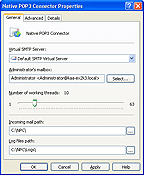
Click here for more screenshots The new version of this popular software product — Native POP3 Connector (hereafter NPC) — is an extension for Microsoft® Exchange Server 2000/2003 and Microsoft® Small Business Server 2000/2003. It is a connector or a gateway to use the terms of the aforementioned products. In this version a lot of program features have been added and all known issues from previous versions have been fixed.

NPC offers a standard solution for the problem with receiving mail through the POP3 protocol for Microsoft Exchange Server 2000/2003 and Microsoft Small Business Server 2000/2003 with Microsoft Exchange Server installed (SBS 2000/2003). NPC is a solution with an affinity to Microsoft Exchange Server 2000/2003 and SBS 2000/2003 — Connector. During the installation, the administrator has an opportunity to install a new type into the Connectors Exchange System Manager group (also available in SBS Administration Console): Native POP3 Connector. Upon installation, all administration procedures are performed in a way standard for Microsoft Exchange 2000/2003 and SBS 2000/2003 — by editing the properties of the Connector installed via Exchange System Manager.

read more...

Definition of: POP3

Definition of: POP3

(Post Office Protocol 3) A standard interface between an e-mail client program and the mail server, defined by IETF RFC 1939. POP3 and IMAP4 are the two common mailbox access protocols used for Internet e-mail. POP3 provides a message store that holds incoming e-mail until users log on and download it.

POP3 is a simple system with limited selectivity. All pending messages and attachments are downloaded when users check their mail. See IMAP4, SMTP and messaging system.

read more...

POP3 Extension Mechanism

POP3 Extension Mechanism


The POP3 Extension Mechanism [RFC 2449] updates RFC 1939 to define a
mechanism to announce support for optional commands, extensions, and
unconditional server behavior. Included is an initial set of
currently deployed capabilities which vary between server
implementations, and several new capabilities (SASL, RESP-CODES,
LOGIN-DELAY, PIPELINING, EXPIRE and IMPLEMENTATION). The RFC also
extends POP3 error messages so that machine parsable codes can be
provided to the client.

read more...

Package com.sun.mail.pop3

Package com.sun.mail.pop3

A POP3 protocol provider for the JavaMail API that provides access to a POP3 message store.

See:
Description

Class Summary
POP3Folder A POP3 Folder (can only be "INBOX").
POP3Message A POP3 Message.
POP3SSLStore A POP3 Message Store using SSL.
POP3Store A POP3 Message Store.

read more...

What Is POP3 Service?

What Is POP3 Service?

In this section

Common POP3 Scenarios

Other E-Mail Retrieval Technologies

POP3 Dependencies

Related Information

The POP3 service supplements existing functionality in Windows Server 2003 provided by the SMTP service, which receives e-mail messages. The POP3 service makes e-mail messages available for download from a server, enabling a server to host e-mail accounts and provide basic e-mail access.

read more...

ANPOP POP3 COMPONENT 7.0 Released

ANPOP POP3 COMPONENT 7.0 Released

Platform: Windows 95/98/2000/NT/ME/XP/2003/Vista Date: Mar 2007
Documentation Download Buy

With only some simple scripts your applications will be enabled to retrieve emails based on POP3 & IMAP4 protocol and parse emails based on MIME with this powerful pop3/imap4 component.

Important notice:* For C#, Visual Basic.NET, Managed C++, J#, JScript.NET and ASP.NET developers, we strongly recommend that you use the pure .NET class EAGetMail POP3 & IMAP4 Component instead of ANPOP POP3 Component.


read more...

An Introduction to the Windows 2003 POP3 Service

An Introduction to the Windows 2003 POP3 Service

What is POP3?

POP3 is a client-server protocol in which email is received and held by a mail server. Messages are downloaded to a local computer all at once, thereby making offline reading easier. You can specify whether to keep copies of the messages on the server. The default port number for POP3 is 110.

What is the POP3 Service?

The POP3 (Post Office Protocol version 3) service is an email service that retrieves email messages. Administrators can use the POP3 service to store and manage email accounts on the mail server. Although the Microsoft Exchange family provides more flexibility to a mail server, the user experience on an email client (such as Outlook Express) - when sending or receiving email - is the same. The end user will not notice the difference when downloading their personal email from the server.

Pros

  • Very good for small sized companies who wish to setup a basic mail system.
  • Support for multiple domains if using either Active Directory or encrypted password file authentication.
  • Cheaper than the alternative method of having to buy Exchange Server.

Cons

  • Windows Server POP3 email should be backed up when it is offline. Having to back up while offline could lead to a service interruption for users.
  • The Windows Server POP3 service does not support AVAPI
read more...

Dovecot

Dovecot

Dovecot is an open source IMAP and POP3 server for Linux/UNIX-like systems, written with security primarily in mind. Dovecot is an excellent choice for both small and large installations. It's fast, simple to set up, requires no special administration and it uses very little memory.

read more...

IMAP vs POP3

IMAP vs POP3

Below is an explanation of the general difference between the IMAP and POP3 email protocols.

IMAP account

Using this protocol, all your mail stays on the server in multiple folders, some of which you have created. This enables you to connect to any computer and see all your mail and mail folders. In general, IMAP is great if you have a dedicated connection to the Internet or you like to check your mail from various locations.

POP3

With this type of email account you only have one folder, the Inbox folder. When you open your mailbox, new mail is moved from the host server and saved on your computer. If you want to be able to see your old mail messages, you have to go back to the computer where you last opened your mail.

With this type of account you do not have to stay logged on to the Internet. You can log on when you want to receive and send new messages. Once your new messages have been downloaded to your computer you can log off to read them. This option is good when you connect with your modem to DAS and are charged for your connection or you have an older computer.

Leave mail on server vs. Remove mail from server

If you use the POP3 protocol and you read your mail from multiple computers, you will want to "leave mail on the server." The reason for this is so that the mail in your Inbox will be available to you at all times. If you do not leave mail on the server, all the mail in your Inbox will be downloaded to the computer you are currently using. If you only read your mail from one location, then there is no need to "leave mail on the server." You will see instructions on how to set this option when you go through the steps to set up your email program.

Why choose IMAP rather than POP3 with "leave mail on server"? With POP3 "leave mail on server" only your email messages are on the server, but with IMAP your email folders are also on the server.

view sidebar content | back to top of page

SQL MAIL and SQL Agent Mail using POP3 and SMTP

SQL MAIL and SQL Agent Mail using POP3 and SMTP
By Gregory A. Larsen

How many times have you had problems sending SQL MAIL or SQL Agent Mail from SQL Server because the Exchange server was taken down or not working? Have you ever tried to connect up SQL Mail and/or SQL Agent mail to Exchange through a firewall or across domains, only to find out that you cannot use your Exchange in these situations? Maybe you don't have Exchange but you would still like to setup SQL Server to send email. If you have experienced these problems then you might want to consider using POP3 and SMTP services for supporting your SQL Mail and SQL Agent mail requirements. This article will discuss how to setup SQL Server to use POP3 and SMTP services to support SQL Mail and SQL Agent mail.

read more...

Python Email Libraries, part 1: POP3

Python Email Libraries, part 1: POP3
(Page 1 of 4 )

Some very useful business software connects with and interacts with email in various ways. If you are building or working with such software, you might want to know how Python accomplishes these tasks. This article series discusses how to use the email libraries built into Python. In this first part, POP3 is covered.

Introduction

Many software systems require the ability to connect with and provide services that interact with email in different ways. Perhaps you’re writing software for a bulletin board that must notify users when new responses are posted in certain topics, or a piece of scheduling software that must notify users when new engagements are assigned to them. There are, of course, many further applications for integration between business or Web software with email.

Integrating with email allows for advantages from both business and portability perspectives. From a business perspective, integrating your software with email allows users to use their email accounts as a central place in which to get notifications and information about a wide range of business objectives. From a portability viewpoint, email adds a layer of abstraction, making it possible for a user to receive alerts from your software in any way they choose: via a classic email client, a Web client from a public computer or home, or even a cell phone or Blackberry capable of accessing standard email protocols.

This article series will discuss how to use the email libraries built in to Python. I will describe how to access email on both POP and IMAP servers, how to parse this mail into easily usable data structures, and how to create email items and then send them through an SMTP server.

read more...

Access Yahoo mail with free POP3 server

Access Yahoo mail with free POP3 server

Some time back, when Yahoo decided on charging users for its POP3 service, many users were upset with the move. Yahoo users need not despair anymore, for there is a new free POP3 server that enables access to Yahoo mail. You can configure Yahoo!POP as the mail proxy on your local host and download all mail or leave a copy on the server. All this and more on IE6 SP1 Gold and free IE-add-ins in this week’s freeloader.

read more...

Using Telnet with a POP3 Mail Server

Using Telnet with a POP3 Mail Server

A Tutorial by Michael Santovec


It is possible, with many ISPs, to use a Telnet program to do maintenance on your mailbox on the POP3 mail server. This allows you to look at, and possibly delete, any problem causing message (e.g. too large to download, improperly formatted message, etc.)

The instructions below are based on the Win95 TELNET.EXE program. See here for some other Telnet programs and operating systems.

read more...

Saturday, May 5, 2007

Free Pop3 / IMAP / SMTP Emails

Free Pop3 / IMAP / SMTP Emails

The Post Office Protocol (Pop3) allows computers to retrieve messages from mailboxes on mail servers. This can be done via email clients or via webbased pop3 readers. Since The POP3 protocol does not support multi-mailbox accounts, it is a better choice to find an imap service. IMAP (Internet Messaging Access Protocol) is more sophisticated than the Post Office Protocol (POP3) protocol. Messages can be archived in folders, mailboxes can be shared, and a user can access multiple mail servers. There is also better integration with MIME, which is used to attach files. On this page you will get the list af free pop3, free imap and free smtp service providers available worldwide! Meanwhile SMTP (Simple Mail Transfer Protocol) servers route SMTP messages throughout the Internet to a mail server, such as POP3 or IMAP4, which provides a message store for incoming mail. You can find more info about these services and terms on F.A.Q page and through the forum. While you are browsing through the pages, please do not hesitate to contact me for any reason you have. To have up-to-date listing please inform me broken/dead links and new services you come across on the net :)

read more...

Free third-party POP3 connector for Exchange Server

Free third-party POP3 connector for Exchange Server

Exchange Server isn't really supposed to connect to an external POP3 mailbox and aggregate email from it, but enough people do it that most Exchange Server administrators have to support it.


VIEW MEMBER FEEDACK TO THIS MICROSOFT EXCHANGE TIP
Of course, any external POP3 mailbox should ideally be phased out at some point, but that hasn't stopped many Exchange administrators from setting up a permanent POP3 connector of some kind -- like the POP3 connector that ships with Microsoft Exchange in Small Business Server 2003, for instance.

If you have no choice but to use that kind of POP3 configuration, you may be interested in PopGrabber, a third-party POP3 connector tool.

Nothing needs to be installed on Exchange Server itself for PopGrabber to work, because it's a standalone program, not an Exchange Server add-on. When installed, it talks to an outside POP3 mailbox at regular intervals, downloads all the email there, and forwards it to another server via SMTP.

The port numbers for all actions can be user-defined, and APOP authentication is supported if you need it (although SMTP authentication is not).

Note that the target server doesn't have to be an Exchange server --any SMTP server will do-- but it works with Exchange Server as transparently as anything else.

The basic, free version of PopGrabber can talk to up to three external email accounts, and forward them all to a single SMTP server. The standard, commercial version of PopGrabber costs U.S. $35 and can retrieve email from and send email to an unlimited number of POP3 and SMTP accounts.

Both versions have a few drawbacks, though. For one, they don't support SSL, for one. However, the program's authors have a workaround for the SSL problem that involves using ClamMail, a free mail proxy and antivirus scanner.

About the author: Serdar Yegulalp is editor of Windows Insight, a newsletter devoted to hints, tips, tricks, news and goodies for all flavors of Windows users.

MEMBER FEEDBACK TO THIS MICROSOFT EXCHANGE TIP

Another good software to use is SmartPOP2Exchange from Jam Software.
—Nick T.

Related information from SearchExchange.com:

Exchange Server and POP3 FAQs

Frequently Asked Questions:

EXCHANGE SERVER AND POP3

  • Protecting your POP3 clients from spam
  • Automatically forward an Exchange account to a POP3 account
  • Forwarding unknown recipient e-mails to a POP3 server
  • Authenticating POP/IMAP users on Exchange Server 2003
  • Migrating POP3 e-mail accounts from a host to an in-house Exchange server
  • POP3 users cannot send mail outside the server
  • POP3 client hangs when downloading messages in Exchange 2003
  • Changing relay restrictions to allow POP3 and IMAP clients to send mail to Exchange Server
  • Configuring mail as plain text for POP3 clients
  • Exporting the Global Address List to POP3 accounts
  • Importing POP3 e-mails to Exchange without third-party software
  • Caching e-mail on Exchange Server 2003 for hosted POP3 accounts
  • POP3 problems after migration to Exchange 2003

  • read more...

    POP

    POP

    (1) Short for Post Office Protocol, a protocol used to retrieve e-mail from a mail server. Most e-mail applications (sometimes called an e-mail client) use the POP protocol, although some can use the newer IMAP (Internet Message Access Protocol).

    There are two versions of POP. The first, called POP2, became a standard in the mid-80's and requires SMTP to send messages. The newer version, POP3, can be used with or without SMTP.

    (2) Short for point of presence, an access point to the Internet. ISPs have typically multiple POPs. A point of presence is a physical location, either part of the facilities of a telecommunications provider that the ISP rents or a separate location from the telecommunications provider, that houses servers, routers, ATM switches and digital/analog call aggregators.

    (3) Short for Programmed Operator (POP), a pseudo-opcode in a virtual machine language executed by an interpretive program. The Programmed Operator instructions provide the ability to define an instruction set for efficient encoding by calling subprograms into primary memory.

    (4) Short for picture-outside-picture POP is a feature found on some televisions that allows the user to divide the screen into two same-size pictures, enabling you to view a second program. Compare with picture-in-picture (PIP).

    POP3

    POP3


    DEFINITION - POP3 (Post Office Protocol 3) is the most recent version of a standard protocol for receiving e-mail. POP3 is a client/server protocol in which e-mail is received and held for you by your Internet server. Periodically, you (or your client e-mail receiver) check your mail-box on the server and download any mail, probably using POP3. This standard protocol is built into most popular e-mail products, such as Eudora and Outlook Express. It's also built into the Netscape and Microsoft Internet Explorer browsers.

    POP3 is designed to delete mail on the server as soon as the user has downloaded it. However, some implementations allow users or an administrator to specify that mail be saved for some period of time. POP can be thought of as a "store-and-forward" service.

    An alternative protocol is Internet Message Access Protocol (IMAP). IMAP provides the user more capabilities for retaining e-mail on the server and for organizing it in folders on the server. IMAP can be thought of as a remote file server.

    POP and IMAP deal with the receiving of e-mail and are not to be confused with the Simple Mail Transfer Protocol (SMTP), a protocol for transferring e-mail across the Internet. You send e-mail with SMTP and a mail handler receives it on your recipient's behalf. Then the mail is read using POP or IMAP.

    The conventional port number for POP3 is 110.

    Using TLS with IMAP, POP3 and ACAP


    Using TLS with IMAP, POP3 and ACAP


    Status of this Memo

    This document specifies an Internet standards track protocol for the
    Internet community, and requests discussion and suggestions for
    improvements. Please refer to the current edition of the "Internet
    Official Protocol Standards" (STD 1) for the standardization state
    and status of this protocol. Distribution of this memo is unlimited.

    read more...

    The SYS and AUTH POP Response Codes

    The SYS and AUTH POP Response Codes


    Status of this Memo

    This document specifies an Internet standards track protocol for the
    Internet community, and requests discussion and suggestions for
    improvements. Please refer to the current edition of the "Internet
    Official Protocol Standards" (STD 1) for the standardization state
    and status of this protocol. Distribution of this memo is unlimited.

    Copyright Notice

    Copyright (C) The Internet Society (2002). All Rights Reserved.

    Abstract

    This memo proposes two response codes: SYS and AUTH, which enable
    clients to unambiguously determine an optimal response to an
    authentication failure. In addition, a new capability (AUTH-RESP-
    CODE) is defined.

    Table of Contents

    1. Introduction . . . . . . . . . . . . . . . . . . . . . . . . 2
    2. Conventions Used in this Document . . . . . . . . . . . . . . 2
    3. Background . . . . . . . . . . . . . . . . . . . . . . . . 2
    4. The SYS Response Code . . . . . . . . . . . . . . . . . . . 3
    5. The AUTH Response Code . . . . . . . . . . . . . . . . . . 3
    6. The AUTH-RESP-CODE Capability . . . . . . . . . . . . . . . 4
    7. IANA Considerations . . . . . . . . . . . . . . . . . . . . 4
    8. Security Considerations . . . . . . . . . . . . . . . . . . 4
    9. References . . . . . . . . . . . . . . . . . . . . . . . . 5
    10. Author's Address . . . . . . . . . . . . . . . . . . . . . . 5
    11. Full Copyright Statement . . . . . . . . . . . . . . . . . 6


    read more...

    POP3 AUTHentication command


    POP3 AUTHentication command


    Status of this Memo

    This document specifies an Internet standards track protocol for the
    Internet community, and requests discussion and suggestions for
    improvements. Please refer to the current edition of the "Internet
    Official Protocol Standards" (STD 1) for the standardization state
    and status of this protocol. Distribution of this memo is unlimited.


    1. Introduction


    This document describes the optional AUTH command, for indicating an
    authentication mechanism to the server, performing an authentication
    protocol exchange, and optionally negotiating a protection mechanism
    for subsequent protocol interactions. The authentication and
    protection mechanisms used by the POP3 AUTH command are those used by
    IMAP4.

    read more...

    POP3 Extension Mechanism


    POP3 Extension Mechanism


    Status of this Memo

    This document specifies an Internet standards track protocol for the
    Internet community, and requests discussion and suggestions for
    improvements. Please refer to the current edition of the "Internet
    Official Protocol Standards" (STD 1) for the standardization state
    and status of this protocol. Distribution of this memo is unlimited.

    Copyright Notice

    Copyright (C) The Internet Society (1998). All Rights Reserved.

    IESG Note

    This extension to the POP3 protocol is to be used by a server to
    express policy descisions taken by the server administrator. It is
    not an endorsement of implementations of further POP3 extensions
    generally. It is the general view that the POP3 protocol should stay
    simple, and for the simple purpose of downloading email from a mail
    server. If more complicated operations are needed, the IMAP protocol
    [RFC 2060] should be used. The first paragraph of section 7 should
    be read very carefully.

    Table of Contents

    1. Introduction . . . . . . . . . . . . . . . . . . . . . . . . 2
    2. Conventions Used in this Document . . . . . . . . . . . . . 3
    3. General Command and Response Grammar . . . . . . . . . . . . 3
    4. Parameter and Response Lengths . . . . . . . . . . . . . . 4
    5. The CAPA Command . . . . . . . . . . . . . . . . . . . . . . 4
    6. Initial Set of Capabilities . . . . . . . . . . . . . . . . 5
    6.1. TOP capability . . . . . . . . . . . . . . . . . . . . . 6
    6.2. USER capability . . . . . . . . . . . . . . . . . . . . 6
    6.3. SASL capability . . . . . . . . . . . . . . . . . . . . 7
    6.4. RESP-CODES capability . . . . . . . . . . . . . . . . . 8
    6.5. LOGIN-DELAY capability . . . . . . . . . . . . . . . . . 8
    6.6. PIPELINING capability . . . . . . . . . . . . . . . . . 9


    Gellens, et. al. Standards Track [Page 1]

    RFC 2449 POP3 Extension Mechanism November 1998


    6.7. EXPIRE capability . . . . . . . . . . . . . . . . . . . 10
    6.8. UIDL capability . . . . . . . . . . . . . . . . . . . . 13
    6.9. IMPLEMENTATION capability . . . . . . . . . . . . . . . 13
    7. Future Extensions to POP3 . . . . . . . . . . . . . . . . . 14
    8. Extended POP3 Response Codes . . . . . . . . . . . . . . . . 14
    8.1. Initial POP3 response codes . . . . . . . . . . . . . . 15
    8.1.1. The LOGIN-DELAY response code . . . . . . . . . . . 15
    8.1.2. The IN-USE response code . . . . . . . . . . . . . 16
    9. IANA Considerations . . . . . . . . . . . . . . . . . . . . 16
    10. Security Considerations . . . . . . . . . . . . . . . . . . 17
    11. Acknowledgments . . . . . . . . . . . . . . . . . . . . . . 17
    12. References . . . . . . . . . . . . . . . . . . . . . . . . 17
    13. Authors' Addresses . . . . . . . . . . . . . . . . . . . . 18
    14. Full Copyright Statement . . . . . . . . . . . . . . . . . . 19

    Post Office Protocol - Version 3

    Post Office Protocol - Version 3


    Status of this Memo

    This document specifies an Internet standards track protocol for the
    Internet community, and requests discussion and suggestions for
    improvements. Please refer to the current edition of the "Internet
    Official Protocol Standards" (STD 1) for the standardization state
    and status of this protocol. Distribution of this memo is unlimited.

    Table of Contents

    1. Introduction ................................................ 2
    2. A Short Digression .......................................... 2
    3. Basic Operation ............................................. 3
    4. The AUTHORIZATION State ..................................... 4
    QUIT Command ................................................ 5
    5. The TRANSACTION State ....................................... 5
    STAT Command ................................................ 6
    LIST Command ................................................ 6
    RETR Command ................................................ 8
    DELE Command ................................................ 8
    NOOP Command ................................................ 9
    RSET Command ................................................ 9
    6. The UPDATE State ............................................ 10
    QUIT Command ................................................ 10
    7. Optional POP3 Commands ...................................... 11
    TOP Command ................................................. 11
    UIDL Command ................................................ 12
    USER Command ................................................ 13
    PASS Command ................................................ 14
    APOP Command ................................................ 15
    8. Scaling and Operational Considerations ...................... 16
    9. POP3 Command Summary ........................................ 18
    10. Example POP3 Session ....................................... 19
    11. Message Format ............................................. 19
    12. References ................................................. 20
    13. Security Considerations .................................... 20
    14. Acknowledgements ........................................... 20
    15. Authors' Addresses ......................................... 21
    Appendix A. Differences from RFC 1725 .......................... 22


    read more...

    Post Office Protocol

    In computing, local e-mail clients use the Post Office Protocol version 3 (POP3), an application-layer Internet standard protocol, to retrieve e-mail from a remote server over a TCP/IP connection. Nearly all subscribers to individual Internet service provider e-mail accounts access their e-mail with client software that uses POP3.

    POP3 has made earlier versions of the protocol obsolete, POP (informally called POP1) and POP2. In contemporary usage, the less precise term POP almost always means POP3 in the context of e-mail protocols.

    The design of POP3 and its procedures supports end-users with intermittent connections (such as dial-up connections), allowing these users to retrieve e-mail when connected and then to view and manipulate the retrieved messages without needing to stay connected. Although most clients have an option to leave mail on server, e-mail clients using POP3 generally connect, retrieve all messages, store them on the user's PC as new messages, delete them from the server, and then disconnect. In contrast, the newer, more capable Internet Message Access Protocol (IMAP) supports both connected and disconnected modes of operation. E-mail clients using IMAP generally leave messages on the server until the user explicitly deletes them. This and other facets of IMAP operation allow multiple clients to access the same mailbox. Most e-mail clients support either POP3 or IMAP to retrieve messages; however, fewer Internet Service Providers (ISPs) support IMAP. The fundamental difference between POP3 and IMAP4 is that POP3 offers access to a mail drop; the mail exists on the server until it is collected by the client. Even if the client leaves some or all messages on the server, the client's message store is considered authoritative. In contrast, IMAP4 offers access to the mail store; the client may store local copies of the messages, but these are considered to be a temporary cache; the server's store is authoritative.

    Clients with a leave mail on server option generally use the POP3 UIDL (Unique IDentification Listing) command. Most POP3 commands identify specific messages by their ordinal number on the mail server. This creates a problem for a client intending to leave messages on the server, since these message numbers may change from one connection to the server to another. For example if a mailbox contains five messages at last connect, and a different client then deletes message #3, the next connecting user will find the last two messages' numbers decremented by one. UIDL provides a mechanism to avoid these numbering issues. The server assigns a string of characters as a permanent and unique ID for the message. When a POP3-compatible e-mail client connects to the server, it can use the UIDL command to get the current mapping from these message IDs to the ordinal message numbers. The client can then use this mapping to determine which messages it has yet to download, which saves time when downloading. IMAP has a similar mechanism, using a 32-bit UID (Unique IDentifier) that is required to be strictly ascending. The advantage of the numeric UID is with large mailboxes; a client can request just the UIDs greater than its previously stored "highest UID". In POP, the client must fetch the entire UIDL map.

    Whether using POP3 or IMAP to retrieve messages, e-mail clients typically use the SMTP_Submit profile of the SMTP protocol to send messages. E-mail clients are commonly categorized as either POP or IMAP clients, but in both cases the clients also use SMTP. There are extensions to POP3 that allow some clients to transmit outbound mail via POP3 - these are known as "XTND XMIT" extensions. The Qualcomm qpopper and CommuniGate Pro servers and Eudora clients are examples of systems that optionally utilize the XTND XMIT methods of authenticated client-to-server e-mail transmission.

    MIME serves as the standard for attachments and non-ASCII text in e-mail. Although neither POP3 nor SMTP require MIME-formatted e-mail, essentially all Internet e-mail comes MIME-formatted, so POP clients must also understand and use MIME. IMAP, by design, assumes MIME-formatted e-mail.

    Like many other older Internet protocols, POP3 originally supported only an unencrypted login mechanism. Although plain text transmission of passwords in POP3 still commonly occurs, POP3 currently supports several authentication methods to provide varying levels of protection against illegitimate access to a user's e-mail. One such method, APOP, uses the MD5 hash function in an attempt to avoid replay attacks and disclosure of a shared secret. Clients implementing APOP include Mozilla, Thunderbird, Opera, Eudora, KMail and Novell Evolution. POP3 clients can also support SASL authentication methods via the AUTH extension.

    POP3 works over a TCP/IP connection using TCP on network port 110. E-mail clients can encrypt POP3 traffic using TLS or SSL. A TLS or SSL connection is negotiated using the STLS command. Some clients and servers, like Google Gmail, instead use the deprecated alternate-port method, which uses TCP port 995.

    Dialog example


    S: 
    C:
    S: +OK POP3 server ready <1896.697170952@dbc.mtview.ca.us>
    C: APOP mrose c4c9334bac560ecc979e58001b3e22fb
    S: +OK mrose's maildrop has 2 messages (320 octets)
    C: STAT
    S: +OK 2 320
    C: LIST
    S: +OK 2 messages (320 octets)
    S: 1 120
    S: 2 200
    S: .
    C: RETR 1
    S: +OK 120 octets
    S:
    S: .
    C: DELE 1
    S: +OK message 1 deleted
    C: RETR 2
    S: +OK 200 octets
    S:
    S: .
    C: DELE 2
    S: +OK message 2 deleted
    C: QUIT
    S: +OK dewey POP3 server signing off (maildrop empty)
    C:
    S:


    POP3 servers without the optional APOP command expect you to log in with the USER and PASS commands:

    C: USER mrose S: +OK User accepted C: PASS mrosepass S: +OK Pass accepted